


How to Read Skincare Ingredient Lists on Indian Body Products (Soap, Body Wash, Deo)
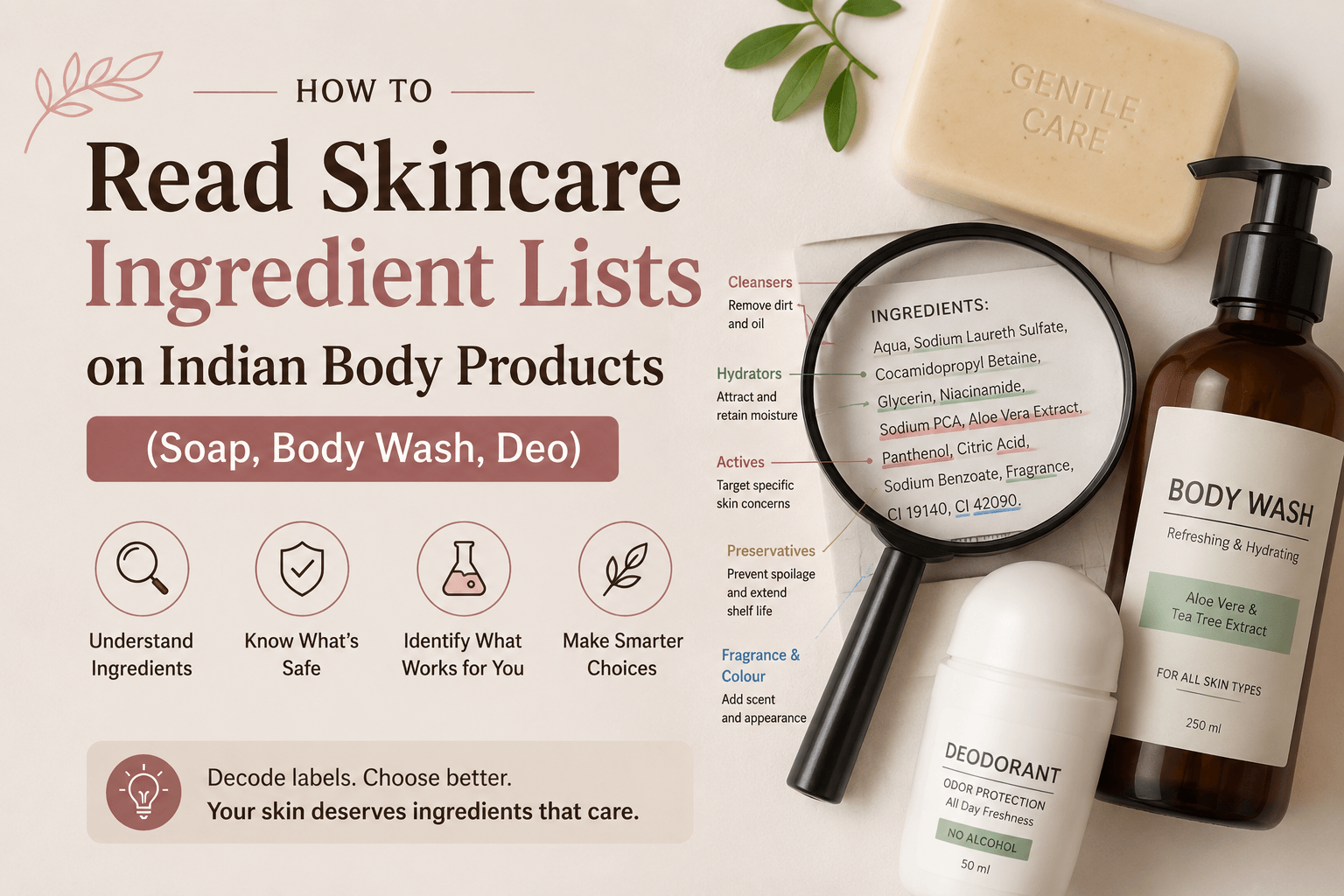
Most Indian body products look similar on the shelf: “brightening,” “moisturising,” “natural,” “gentle.” But the ingredient list on the back tells a much truer story than the claims on the front. If you know how to read that list—even in basic terms—you can instantly tell whether a soap, body wash or deodorant is actually gentle and effective, or just clever marketing.
This guide breaks down how Indian ingredient lists work, how to spot the good stuff (humectants, emollients, actives) and how to notice red-flag ingredients many people prefer to avoid. It’s also where WildOak’s “cleaner” everyday bodycare philosophy fits in naturally.
1. Basics: How Ingredient Lists Work in India
In India, the Bureau of Indian Standards (BIS) requires cosmetic products to list ingredients in descending order of concentration. The first ingredients are present in the highest amounts; the later ones are there in smaller and smaller percentages.
The first 3–5 ingredients usually make up most of the formula.
Once you reach the first preservative (like phenoxyethanol, sodium benzoate, potassium sorbate), most ingredients listed after that are at roughly 1% or less.
“Hero” ingredients (like kojic acid, aloe vera, niacinamide) can still work at low levels, but if they only appear right at the end, they’re more of a supporting act than the main reason to buy the product.
So, whenever you pick up a soap, body wash or deo, focus on:
What’s in the top 5 (your base).
Where the actives sit (top/middle or bottom).
How honest the front claims are compared with the back label.

Vitamin C & Shea Butter Sugar Body Scrub – For Bright, Smooth & Soft Skin
2. The Main “Families” of Skincare Ingredients
Most body products combine three big families of ingredients: humectants, emollients and occlusives. Understanding these helps you judge how a formula will feel on the skin.
-Humectants (water-pullers): attract and bind water to the skin surface. Examples: glycerin, hyaluronic acid, sorbitol, propanediol.
-Emollients (skin softeners): smooth and soften by filling gaps in the skin barrier. Examples: shea butter, cocoa butter, squalane, plant oils, esters like caprylic/capric triglyceride.
-Occlusives (moisture sealers): form a protective film to reduce water loss. Examples: petrolatum, dimethicone, certain waxes.
In a body soap or body wash:
Seeing glycerin in the top half of the list is generally a good sign; it suggests the formula won’t be ultra-stripping.
Plant oils, butters or emollients in the mid-section support a more conditioning cleanse.
In an underarm product:
Niacinamide + humectants + emollients earlier in the list means the formula thinks about skin health, not just fragrance and sweat control.

5% Benzoyl Peroxide Acne Wash for Face & Body- Clears Body Acne Fast
3. How to Read Soap and Body Wash Labels
Most soaps and body washes are built around surfactants (cleansing agents) plus moisturisers, actives and fragrance.
-Surfactants: the cleansing base
Common surfactants include:
-Sodium lauryl sulfate (SLS) and sodium laureth sulfate (SLES).
-Sodium cocoyl isethionate, sodium laureth sulfoacetate.
-Cocamidopropyl betaine and similar amphoteric surfactants.
A “cleaner” or gentler body wash often:
Uses milder surfactants (SLES, cocamidopropyl betaine, sulfate-free systems).
Balances them with humectants (glycerin), emollients (oils, butters) and soothing ingredients.

Kojic Acid Brightening Body Wash - Wildoak
Actives and support ingredients
In a brightening or acne-fighting body wash, look for:
-Kojic acid, niacinamide, alpha arbutin for pigmentation and tan.
-Lactic, glycolic, mandelic acid or salicylic acid for exfoliation and texture.
-Aloe vera, panthenol, allantoin for soothing.
If these actives sit somewhere in the top or middle of the list, they’re likely doing more than just being a marketing claim.
4. How to Read Deodorant and Underarm Labels
Deodorants and antiperspirants are often where irritants and heavy fragrance show up.
Things you’ll commonly see:
-Alcohol denat / Ethyl alcohol – often high up in sprays and roll-ons, can sting and dry the area.
-Fragrance / Parfum – typically a mix of aroma chemicals; high placement means strong fragrance load.
-Aluminium salts (in antiperspirants) – reduce sweating by blocking ducts, not a pigment issue but something some users avoid.
For a skin-friendly underarm formula, it helps if you see:
Niacinamide, lactic/mandelic acid, kojic acid, zinc, aloe – underarm-relevant actives for pigmentation, texture and odour control.
Glycerin or other humectants – to counteract dryness.
Fragrance lower in the list, not in the top 3–4 ingredients.
This is where WildOak’s formulations (brightening + odour control with AHAs, kojic acid and niacinamide) are very different from typical mass-market deos that lead with alcohol and parfum.

Kojic Acid & Alpha Arbutin Soap for Dark Spots & Hyperpigmentation - Pack of 3
5. Ingredients Many People Prefer to Avoid (or Limit)
Different people have different comfort levels, but “cleaner formulation” discussions tend to call out a similar set of ingredients as red flags or “watch out” items in soaps, body washes and deos:
-Harsh sulfates, especially SLS
Strong cleansing, but can strip the barrier and cause dryness or irritation, particularly with frequent use.
-Parabens (methylparaben, propylparaben, etc.)
Effective preservatives, but widely avoided by many “clean” brands due to consumer concerns.
-Phthalates (often hidden in “fragrance”)
Plasticisers that can appear in scented products; often mentioned in lists of chemicals to avoid.
-Triclosan / Triclocarban
Antibacterial agents previously common in soaps and body wash; now often flagged due to potential health and environmental issues.
Strong synthetic fragrance and dyes
“Parfum” high in the list and multiple CI colourants can increase the risk of irritation in sensitive users.
If a product is marketed as “gentle,” “clean” or “for sensitive skin” but leads with heavy sulfates, alcohol and strong fragrance, the ingredient list is telling a different story from the marketing.
6. Are the “Hero” Ingredients Real or Just Marketing?
You’ll often see front labels screaming:
-“With Kojic Acid & Vitamin C”
-“Infused with Aloe Vera & Shea Butter”
-“Niacinamide Brightening Formula”
The INCI list shows how serious that claim is.
Simple tests:
-If kojic acid / niacinamide / alpha arbutin appears in the first half of the list (before or close to the preservative line), it is likely present at a functionally useful level.
If those actives are bunched right at the end, after preservatives and fragrance, they may be there at 1% or less—fine for support, but unlikely to be the sole driver of visible results.
The more an ingredient is shouted about on the front, the more you should check whether it’s truly present in the formula backbone or just sprinkled in.
7. A Quick 30-Second Label Scan Checklist
When you’re shopping for soap, body wash or deo, run through this quick scan:
-First 5 ingredients
Do you see only harsh sulfates and alcohol, or also glycerin, Aloe, oils or humectants?
-Active ingredients
Are brightening/soothing/anti-acne actives (kojic, niacinamide, lactic, salicylic, zinc, aloe) in the top or middle of the list?
-Preservative line
Identify the first preservative (often phenoxyethanol). Know that anything after that is at about 1% or less.
-Red flags
Check for SLS, lots of parabens, triclosan/triclocarban, phthalates, very high “Fragrance/Parfum”.
-Does it match the marketing?
If the front says “gentle” and “brightening” but the back is mostly sulfates, alcohol and perfume, it’s less aligned with a WildOak-style, body-first philosophy.
Where WildOak Fits In
When readers learn to read labels, they start to see a difference between:
-Formula bases built mostly from cheap surfactants and fragrance.
-Formulas built with a balance of humectants, emollients and well-positioned actives chosen specifically for body concerns like tan, pigmentation, underarm odour and body acne.
WildOak can position its soaps, body washes and underarm products as:
-Clear about ingredients.
-Formulated with kerbside recognisable, research-backed actives (kojic acid, alpha arbutin, niacinamide, lactic/mandelic acids, zinc) in thoughtful positions on the INCI list.
-Minimising common “red flag” ingredients many conscious users want to avoid in daily bodycare.
FAQ for How to Read Skincare Ingredient Lists on Indian Body Products
Ques. 1. Why are skincare ingredients listed in a specific order?
Ans. 1. In India, cosmetic regulations require ingredients to be listed in descending order of concentration, so the first few ingredients make up most of the formula and the last ones are present in very small amounts.
Ques. 2. Which part of the ingredient list matters most?
Ans. 2. The first 3–5 ingredients matter most because they usually form the bulk of the product, while ingredients listed after the first preservative (like phenoxyethanol) are typically at around 1 percent or less and act more as support than as main actives.
Ques. 3. How can I tell if a body wash or soap is gentle?
Ans. 3. Check if the formula balances its cleansing agents with humectants and emollients by looking for glycerin, plant oils, butters or soothing ingredients like aloe and panthenol in the top or middle of the ingredient list rather than relying only on strong sulfates.
Ques. 4. What are “humectants,” “emollients” and “occlusives” on labels?
Ans. 4. Humectants such as glycerin and hyaluronic acid attract water to the skin, emollients like shea butter and plant oils soften and smooth, while occlusives such as petrolatum and dimethicone form a protective film to reduce water loss.
Ques. 5. Which ingredients should I watch out for in soaps and body washes?
Ans. 5. Many ingredient guides suggest limiting harsh sulfates like SLS, multiple parabens, antibacterial agents like triclosan or triclocarban, strong synthetic fragrances and certain phthalates, especially if you have sensitive or reactive skin.


